
Scotland County Obituary and Death Records
Scotland County, North Carolina sits in the southern part of the state along the South Carolina border, with Laurinburg serving as the county seat. Researching obituary records here means working with official death certificates at the Scotland County Register of Deeds, which holds documents dating back to 1913. Beyond that office, genealogists will find useful materials through NCGenWeb, state archives, and digitized newspaper collections. This guide explains where Scotland County obituary and death records are kept, how to access them, and what each source provides.
Scotland County Quick Facts
Scotland County Register of Deeds - Obituary and Death Records
The Scotland County Register of Deeds in Laurinburg is the first place researchers should contact when looking for official death documentation in this part of southern North Carolina. Death certificates on file at the Register of Deeds begin in 1913, the year North Carolina established a statewide vital records system. Under North Carolina General Statute 130A-93, death certificates are filed locally and forwarded to the state for central recordkeeping.
Certified copies of death certificates are available for $10 each. Requests can be made in person at the Laurinburg office, submitted by mail, or handled through available online services. The Register of Deeds office is open Monday through Friday during standard business hours. Staff are familiar with records going back through the full span since 1913 and can assist with identifying whether a particular record is on file.
Land records in Scotland County extend back to 1899, when the county was carved from Richmond County. Marriage records begin around the same period. For updated contact details, current hours, and online request options, use the NC Register of Deeds directory provided by the North Carolina Association of Register of Deeds.
| Office |
Scotland County Register of Deeds 212 Biggs Street Laurinburg, NC 28352 Phone: (910) 277-2566 |
|---|---|
| Hours | Monday through Friday, 8:00 AM to 5:00 PM |
| Death Records | 1913 to present |
| Land Records | 1899 to present |
Note: Office hours and availability can change. Contact the Register of Deeds in Laurinburg directly before making a trip to confirm current details.
About Scotland County, North Carolina
Scotland County was formed in 1899 from Richmond County. It takes its name from Scotland, the homeland of many of the Scots who settled this part of North Carolina in the eighteenth and nineteenth centuries. That heritage is still visible in local place names, family surnames, and the cultural traditions of the Laurinburg area.
Laurinburg anchors the county as its seat of government and largest municipality. St. Andrews University, now part of Webber International University, has had a long presence in the city. The county's location on the South Carolina border means some family histories cross state lines, and researchers may need to consult records in both states to build a complete picture.
Before Scotland County was established in 1899, the area was part of Richmond County. Death records and other documents from before 1899 should be sought through Richmond County sources rather than Scotland County offices. The NC State Archives in Raleigh holds materials from Richmond County that predate the formation of Scotland County.
Scotland County Obituary Records at NCGenWeb
NCGenWeb operates a Scotland County page that aggregates genealogy resources compiled by volunteer researchers. The site at ncgenweb.us/scotland offers transcribed records, cemetery inventories, family histories, and links to additional sources covering Scotland County obituary and death research. Materials on the NCGenWeb site frequently predate the 1913 official vital records era, making this a particularly important resource for earlier generations.
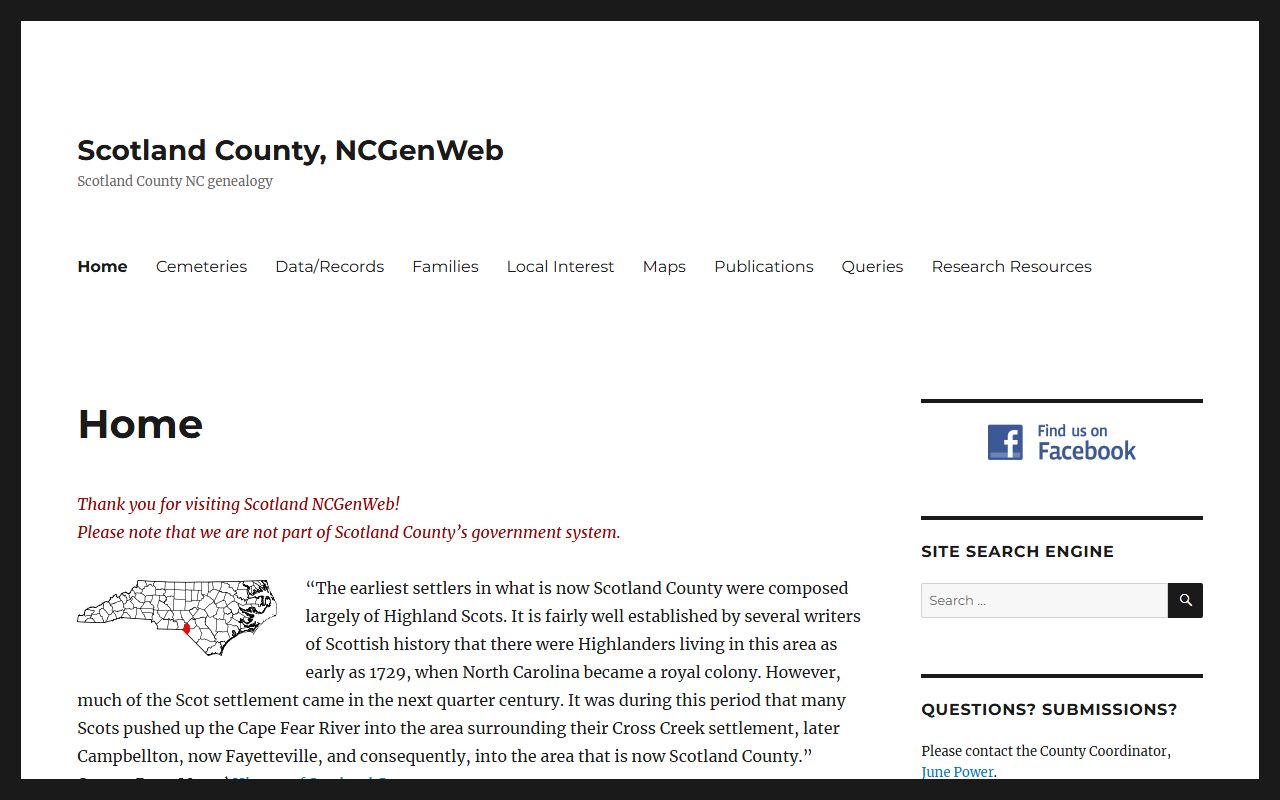
The Scotland County NCGenWeb page connects researchers to volunteer-compiled cemetery transcriptions, church registers, and newspaper death notices that are otherwise difficult to locate in a single place.
Volunteer contributors have uploaded transcriptions of Bible records, church registers, and historical newspaper death notices spanning many decades. These materials are especially helpful when official death certificates are unavailable or when researchers want to learn more about a person beyond the basic facts recorded on a government document.
North Carolina State Vital Records for Scotland County Obituary Searches
The North Carolina Vital Records office in Raleigh maintains a statewide repository of death certificates, including those filed in Scotland County since 1913. Researchers who prefer not to contact the Laurinburg office directly can request certified copies through the state office instead. Both sources draw from the same underlying records created under NCGS 130A-93.
Details on ordering certified death certificates by mail, online, or in person are available at vitalrecords.nc.gov. The state office processes requests from across North Carolina and handles larger volumes than individual county offices. Processing times may differ from those at the Scotland County Register of Deeds, so checking both options before submitting a request is worthwhile.
An online index for older records that have been digitized helps researchers confirm whether a specific death record exists before ordering a certified copy. This is useful when the exact year of death is uncertain, since it avoids fees for searches that come back empty.
How to Search Scotland County Death and Obituary Records
Searching Scotland County obituary records effectively requires knowing which source covers the time period and record type you need. Different repositories hold different kinds of documentation, and combining them produces the most complete results.
Official death certificates from 1913 forward are held at the Scotland County Register of Deeds. Contact the Laurinburg office by phone at (910) 277-2566 or visit in person. Mail requests are accepted as well. You will need the full name of the deceased, an approximate date of death, and any documentation establishing your eligibility under NCGS 130A-93.1, which governs access to vital records in North Carolina.
Key sources for a thorough Scotland County obituary search include:
- Scotland County Register of Deeds for certified death certificates from 1913 onward
- NCGenWeb Scotland County page for volunteer-compiled records and cemetery listings
- NC Vital Records in Raleigh as an alternate source for state death certificates
- DigitalNC for digitized historical newspapers containing death notices and obituaries
- NC State Archives for older genealogy materials and microfilmed county records
- NC Digital Collections for additional digitized historical documents
- Richmond County records for deaths before 1899 in this region
Newspaper obituaries often include details that official certificates omit. Survivors, church affiliations, occupations, and community roles commonly appear in obituary columns but not on death certificates. Searching both types of sources together gives a richer picture of the person you are researching.
Note: Under NCGS 130A-93.1, some portions of a death certificate may be restricted for a period of years following the death. The Register of Deeds staff in Laurinburg can clarify exactly which portions of any given record are accessible.
NC State Archives - Scotland County Historical Death Records
The North Carolina State Archives in Raleigh maintains historical records from counties throughout the state. Scotland County researchers who need materials not held at the local Register of Deeds may find relevant collections at the Archives, including microfilmed vital records, church registers, and other genealogy sources. The Archives reading room is open to the public, and staff archivists can guide researchers to Scotland County-specific holdings.
Finding aids and research guides are available at archives.ncdcr.gov. The site includes guidance tailored specifically to genealogy research, with instructions for navigating both the digital catalog and the physical collections stored in Raleigh. Scotland County materials transferred to the Archives over the years include records from various county offices spanning multiple generations of county history.
Researchers tracing ancestors who lived in Richmond County before Scotland County was carved from it in 1899 should look at Richmond County holdings in the State Archives, since those records document the same geographic area under an earlier administrative name.
DigitalNC - Scotland County Obituary Newspaper Archives
DigitalNC at digitalnc.org provides free access to digitized North Carolina newspapers, including regional publications that served southern NC communities. Death notices and obituaries published in papers serving the Laurinburg area can be searched through this platform without visiting a library or archives reading room. The collection continues to grow as more newspaper runs are digitized.
Searches on DigitalNC work best with a full name combined with terms such as "obituary," "died," or "death." Results are displayed as scanned newspaper pages and can be downloaded as PDFs. These obituary columns frequently provide biographical detail far beyond what a death certificate captures, including names of surviving relatives, place of burial, and church membership.
The NC Digital Collections at digital.ncdcr.gov rounds out the picture with digitized photographs, county documents, and manuscript collections that supplement newspaper archives for Scotland County genealogy research.
Nearby Counties
Scotland County borders several counties in the southern North Carolina coastal plain and Piedmont transition zone. When a death's location is uncertain, checking adjacent county records is a practical next step.