
Cabarrus County Obituary Records and Genealogy
Cabarrus County obituary records are accessible through multiple local and state resources centered on Concord. The Register of Deeds maintains vital records including birth, death, and marriage certificates, while the Cabarrus County Library's Lore Room holds a remarkable genealogy collection with materials dating to 1750. This guide walks through each resource available for searching Cabarrus County obituary and death records, from official death certificates to compiled newspaper indexes and cemetery surveys.
Cabarrus County Quick Facts
Cabarrus County Register of Deeds Obituary and Death Records
The Cabarrus County Register of Deeds in Concord is the official keeper of vital records including birth, death, and marriage certificates. Death records registered in Cabarrus County follow the statewide system that began in 1913 under North Carolina law. The office provides both certified and informational copies of these documents, with the type available depending on the requester's relationship to the record under NCGS 130A-93.
Certified copies cost $10 each. The online index at cabarruscountyrod.org allows remote searching. Researchers can identify records before visiting in person or submitting a formal request by mail. This online index is particularly convenient for Cabarrus County obituary research when you need to confirm a death date or locate a record number before ordering a copy.
The office is located at 65 Church Street SE in Concord. Phone: 704-920-2112. The county website at cabarruscounty.us/departments/register-of-deeds provides request forms and guidance on the process.
| Office |
Cabarrus County Register of Deeds 65 Church Street SE Concord, NC 28025 Phone: 704-920-2112 |
|---|---|
| Vital Records | Birth, death, and marriage certificates |
| Online Index | Available at cabarruscountyrod.org |
| Certified Copy Fee | $10 per certificate |
| Website | cabarruscounty.us/departments/register-of-deeds |
The image below shows the Cabarrus County Register of Deeds website, where the online index for obituary and death records is accessible.
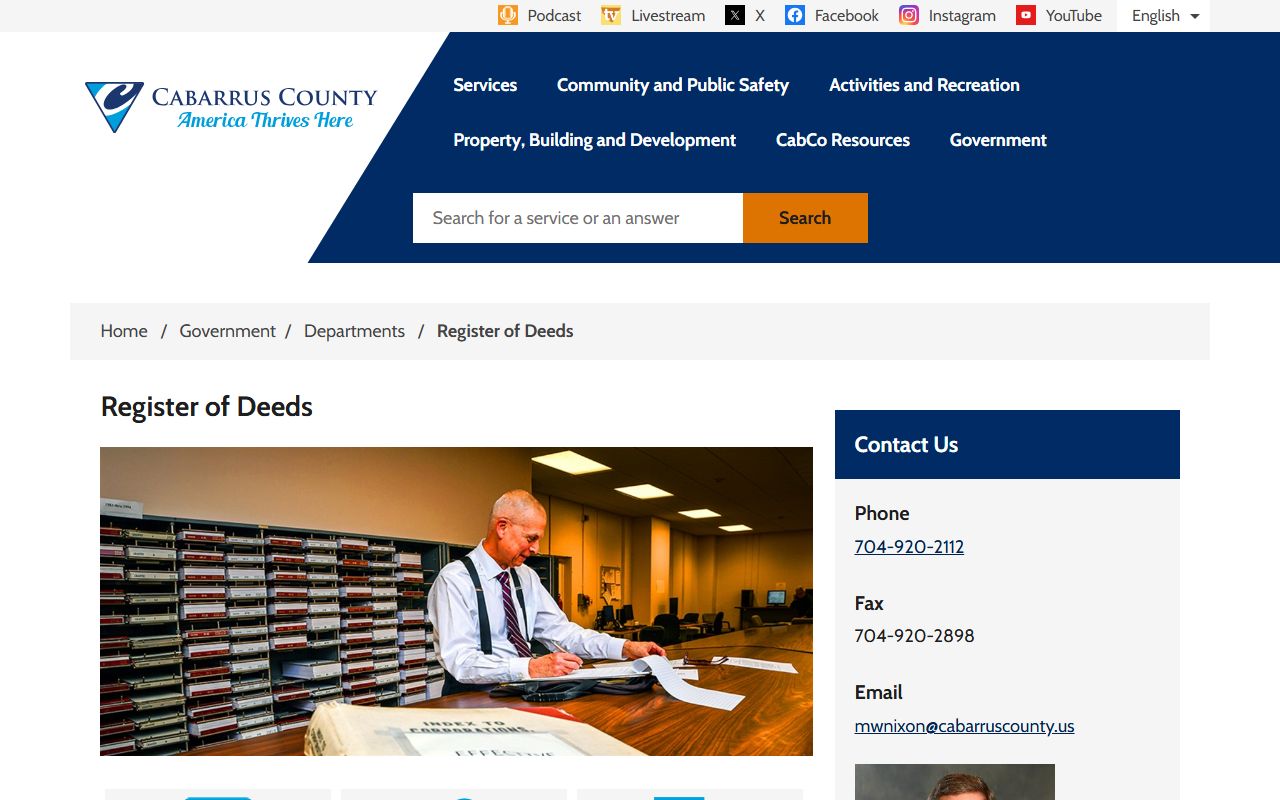
The online index is a practical first step in any Cabarrus County death record or obituary search.
Note: The online index may not include all record types or all years, so contact the office directly for records that do not appear in the digital index.
Cabarrus County Library Lore Room Obituary and Genealogy Records
The Cabarrus County Public Library maintains the Lore Room, a dedicated genealogy and local history collection that is one of the finest county-level genealogical resources in the Piedmont region. Materials in the Lore Room include deeds, wills, court minutes, and newspaper records dating back to 1750. These documents span the full range of Cabarrus County history and are essential for obituary research covering periods before official death registration began.
Compiled cemetery surveys, family histories, and obituary clipping files are available in the Lore Room. Volunteer researchers and library staff have built these indexes over many years. A well-organized surname file covers many of the families documented in Cabarrus County newspapers and church records. Searching the Lore Room's indexes can quickly identify whether an obituary notice exists for the person you are researching in Cabarrus County.
The library is located in Concord and accessible to the public during regular business hours. Specific questions about the Lore Room's holdings can be directed to the library's local history staff. Contact details and hours are available at cabarruscounty.us/Government/Departments/Library/Local-History-Resources.
The Lore Room holds newspaper records that include obituary columns from Cabarrus County publications stretching back to the nineteenth century. These original newspaper files complement the microfilm holdings and give researchers direct access to primary source obituary text.
The image below shows the Cabarrus County Library local history resources page, which describes the Lore Room's collections relevant to obituary and death record research.
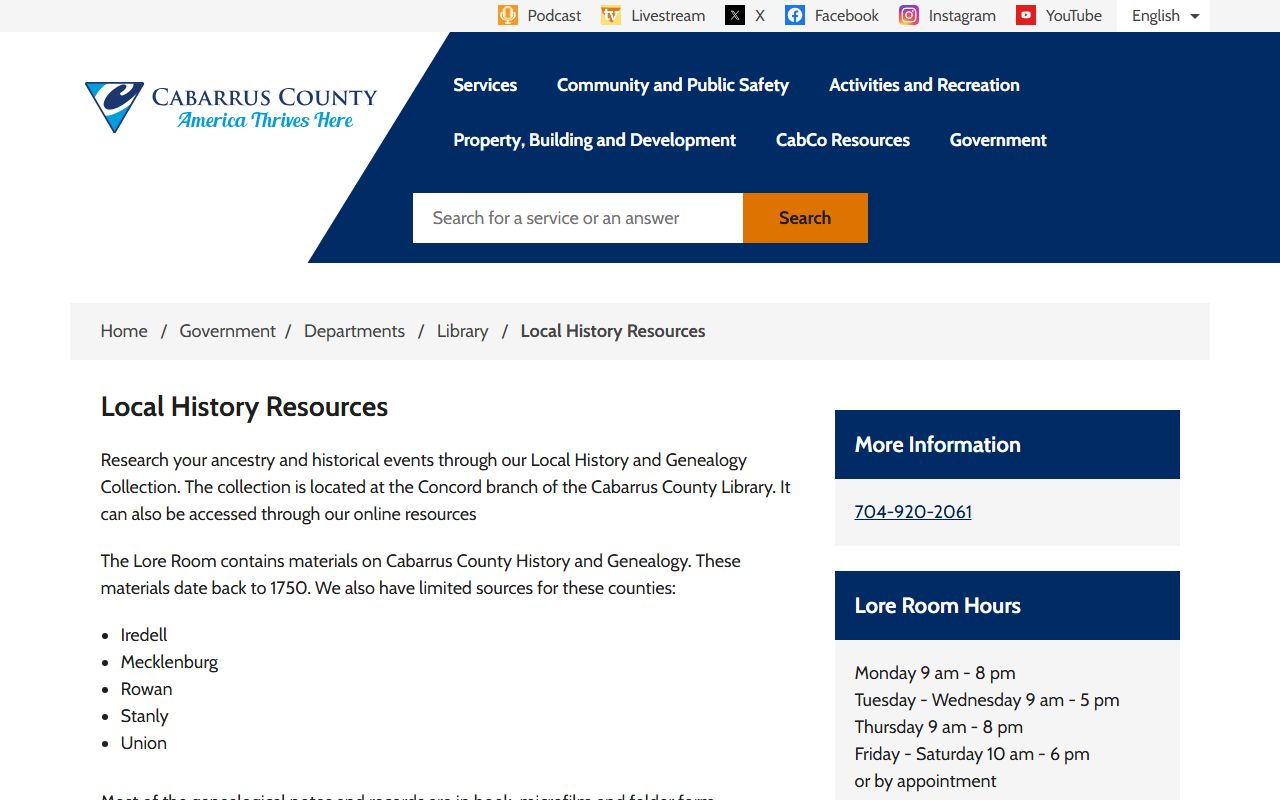
The Lore Room's depth of coverage makes the Cabarrus County Library an essential stop for serious genealogical research into local death and obituary records.
Cabarrus County History and Death Record Background
Cabarrus County was formed in 1792 from Mecklenburg County. The county is famous for Reed Gold Mine, the site of the first documented gold find in the United States in 1799, which triggered North Carolina's gold rush era. This history shaped the settlement patterns and family records of the region through the nineteenth century.
Concord, the county seat, grew significantly with the textile industry in the late nineteenth and early twentieth centuries. Many Cabarrus County families have deep roots in these mill communities, and their deaths are documented in church records, mill company records, and local newspaper obituaries that supplement the official death registration files.
Before the county's formation in 1792, records for what is now Cabarrus County appear in Mecklenburg County files. Researchers working on very early Cabarrus County obituary research should consult Mecklenburg records at the NC State Archives for the period before 1792. The Lore Room's courthouse records dating to 1750 give an unusually early starting point for local genealogical research within the county's current boundaries.
Note: The Reed Gold Mine area attracted immigrants from Germany and other European countries in the 1800s. Church records from German Lutheran and Reformed congregations in Cabarrus County may document deaths not captured in general county records until after formal death registration began in 1913.
Cabarrus County Newspaper Obituary Archives
The Cabarrus County area has been served by local newspapers for well over a century. The Independent Tribune is the current primary newspaper covering Concord and the broader county. Historical papers serving the region include the Concord Daily Tribune and earlier weeklies. Their obituary columns document generations of Cabarrus County residents.
Microfilm of local Cabarrus County newspapers is available at the county library's Lore Room and potentially through interlibrary loan from the State Library of North Carolina. The DigitalNC platform at digitalnc.org has digitized some NC newspaper runs that may include Cabarrus County publications. Searching that archive by name or keyword is a useful supplement to physical microfilm research.
For current Cabarrus County obituaries, funeral home websites serving Concord and Kannapolis post notices online. Searching by surname across active funeral home sites gives rapid results for recent deaths in Cabarrus County.
NC Vital Records and State Archives for Cabarrus County Obituary Research
The North Carolina Vital Records office in Raleigh holds death records for all 100 counties, including Cabarrus. Requests can be submitted by mail, in person, or through authorized online services. The fee and eligibility structure follows NCGS 130A-93, the same statute that governs the county-level office. State records are especially useful when a Cabarrus County death was registered but the county's own copy is not readily accessible.
NCGS 130A-115 allows for delayed registration of deaths that were never formally recorded. If you cannot find a death certificate for a Cabarrus County individual who died after 1913, contact the state Vital Records office to inquire whether a delayed registration is possible and what documentation would be needed to support that process.
The NC State Archives at 109 East Jones Street in Raleigh holds early Cabarrus County court records, estate files, and wills. These documents are the primary source for death-related research covering the period from the county's founding in 1792 through the start of formal death registration in 1913. Searching the archives catalog online at archives.ncdcr.gov before visiting in person helps narrow the research scope.
Nearby Counties
Cabarrus County is located in the North Carolina Piedmont and shares borders with several nearby counties. Deaths near county boundaries may appear in neighboring records.